| 🥩 Food Type | Dry Food |
| 📅 Life Stage | Adult |
| 💪 Health Needs | Skin & Coat|Digestive Health|Joint Support|Weight Management |
| 📏 Breed Size | Medium Breed |
| 🏷️ Brand | Royal Canin |
| ⭐ Our Rating | 4.5 / 5 |
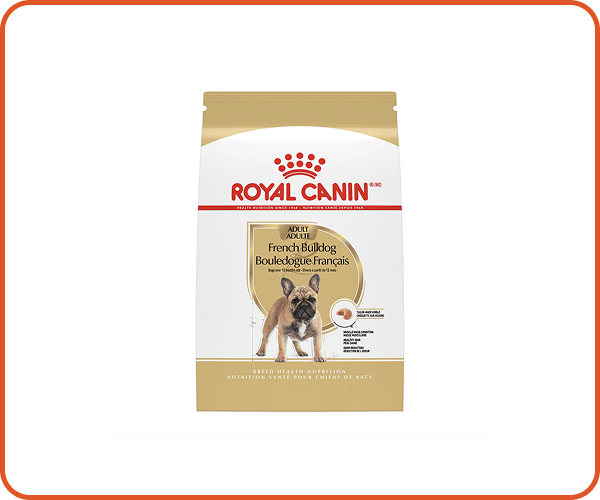
This Royal Canin French Bulldog Adult Breed Health Nutrition review covers one of the most specific products in the dog food market — a formula engineered exclusively for a single breed's anatomy, metabolism, and health vulnerabilities. The French Bulldog's brachycephalic skull, undershot jaw, and flat muzzle create real eating challenges: standard kibble shapes can be difficult to pick up, hard to chew, and easy to swallow whole, leading to gulping, choking, and excess air intake that worsens the breed's already legendary flatulence. Royal Canin's answer is a custom-curved kibble shape paired with a nutrient profile targeting muscle maintenance, skin health, and digestive odor reduction. Whether this engineering justifies the significant price premium over general-purpose kibble is the central question for any French Bulldog owner evaluating their options.
Royal Canin was founded in 1968 in Gard, France, by veterinarian Dr. Jean Cathary, who believed that nutrition was the first line of medicine for companion animals. The company grew from a single formula into a global operation now owned by Mars, Incorporated — the same parent company behind Pedigree, Iams, Eukanuba, and Nutro. Royal Canin operates its own manufacturing facilities in Missouri and South Dakota, where all U.S.-distributed products are made. The company employs a research-first approach, collaborating with veterinarians, breeders, and animal nutritionists worldwide to develop breed-specific, size-specific, and condition-specific diets. The Breed Health Nutrition line — which includes formulas for over 40 individual breeds — represents this philosophy at its most granular.
The ingredient list opens with brewers rice, followed by wheat — two grain sources occupying the first and second positions ahead of any animal protein. This is the single most polarizing aspect of the formula and the primary criticism it draws from ingredient-focused reviewers. Brewers rice is a milled rice by-product from the brewing industry — not whole grain rice — and serves as a highly digestible carbohydrate source. Wheat provides additional carbohydrate energy and gluten structure. Together, these two grains form the caloric and structural backbone of the kibble.
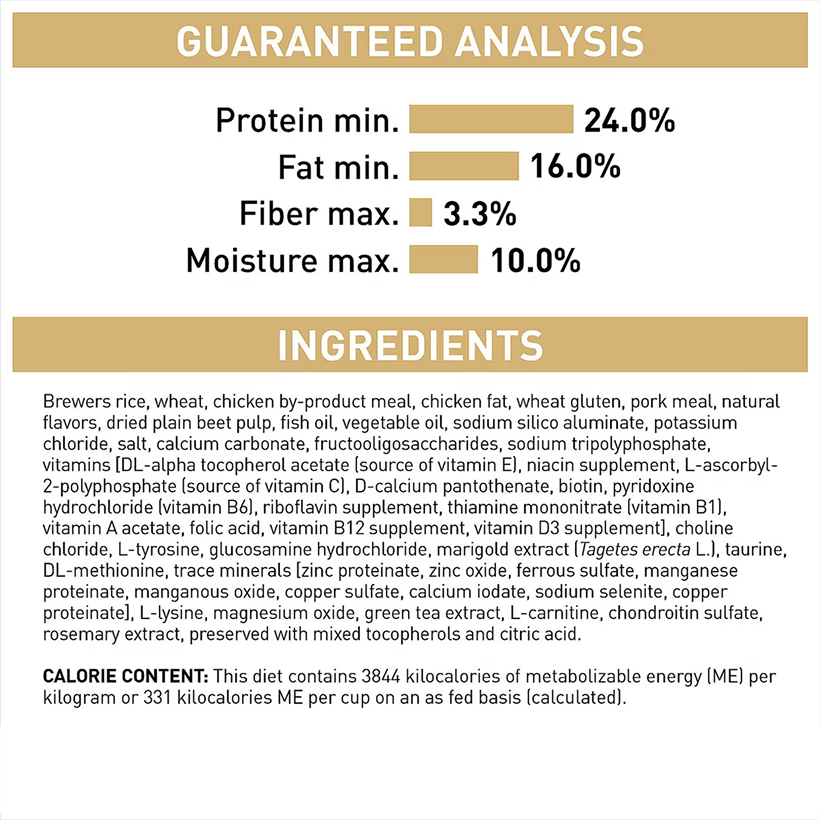
Chicken by-product meal appears third — a concentrated protein source made from rendered chicken parts including necks, feet, intestines, and undeveloped eggs. Royal Canin openly defends its use of by-product meal, stating that it allows the company to maintain precise nutrient standards while achieving sustainable ingredient sourcing. By-product meal is not the same as fresh chicken — it lacks the consumer appeal of whole meat — but it is a protein-dense ingredient that delivers consistent amino acid profiles when properly processed.
Chicken fat in position four provides essential fatty acids and palatability. Wheat gluten follows as an additional plant-based protein source that boosts the overall protein percentage while providing structural integrity to the kibble shape. Pork meal adds a second animal-derived protein source further down the list.
The functional additions are where Royal Canin's formulation expertise shows. Fish oil provides EPA and DHA omega-3 fatty acids for skin barrier support — critical for a breed prone to dermatitis, fold dermatitis, and allergic skin conditions. Dried plain beet pulp serves as a prebiotic fiber source that supports digestive health and stool quality. Fructooligosaccharides (FOS) provide additional prebiotic support for beneficial gut bacteria. L-tyrosine is an amino acid that supports skin pigmentation and coat color. Marigold extract (Tagetes erecta) is a natural source of lutein, an antioxidant supporting skin and eye health. Green tea extract provides polyphenol antioxidants, and sodium silico aluminate functions as a toxin binder in the digestive tract.
The formula also includes glucosamine hydrochloride, chondroitin sulfate, L-carnitine, taurine, and DL-methionine — a comprehensive suite of functional amino acids and joint-support compounds. The entire formula is preserved naturally with mixed tocopherols, citric acid, and rosemary extract.
The guaranteed analysis reads:
Dry matter basis calculations with 10% moisture:
At 26.7% dry matter protein, this formula sits on the lower end for adult dog food — a point that ingredient-focused critics consistently raise. Royal Canin's position is that French Bulldogs, as a brachycephalic breed with moderate activity levels, do not require the 30–35% protein levels that more active breeds benefit from, and that excess protein can actually increase digestive fermentation and gas production in this breed. The 17.8% DMB fat is appropriately higher, providing concentrated energy without requiring large meal volumes — important for a breed prone to obesity. The estimated carbohydrate content around 40–44% is high, driven by the grain-dominant first half of the ingredient list.
The standout supplementation detail is glucosamine at 743 mg/kg — one of the higher guaranteed levels in any non-senior, non-joint-specific formula. French Bulldogs are prone to hip dysplasia and intervertebral disc disease, making proactive joint support particularly relevant. The guaranteed EPA and DHA levels provide transparency on the omega-3 fatty acids most directly linked to skin barrier function. Caloric density sits at 3,844 kcal/kg or 331 kcal per cup, which is moderate and supports controlled feeding for a breed that gains weight easily.
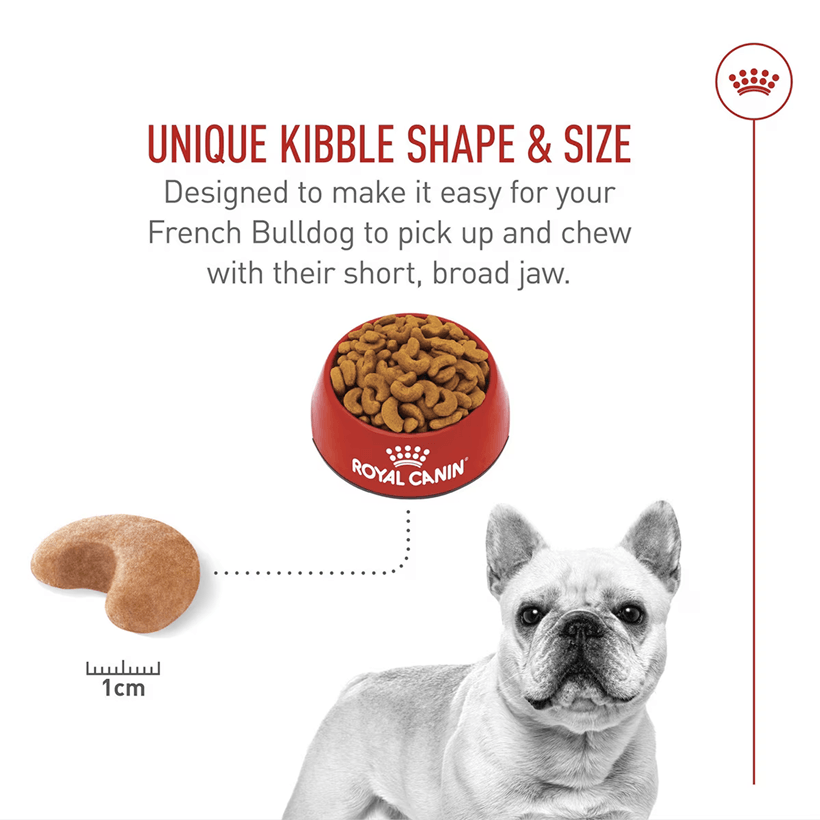
Royal Canin's breed-specific kibble shape for the French Bulldog is a curved, boomerang-like piece that is larger than what most small-breed owners expect. The shape is designed around the Frenchie's brachycephalic jaw structure and undershot bite — the curve allows the dog to scoop the kibble with the lower jaw rather than requiring precise front-teeth picking that flat-faced dogs struggle with. The larger-than-expected size forces chewing rather than gulping, which reduces air intake and theoretically decreases the gas and bloating that plague the breed.
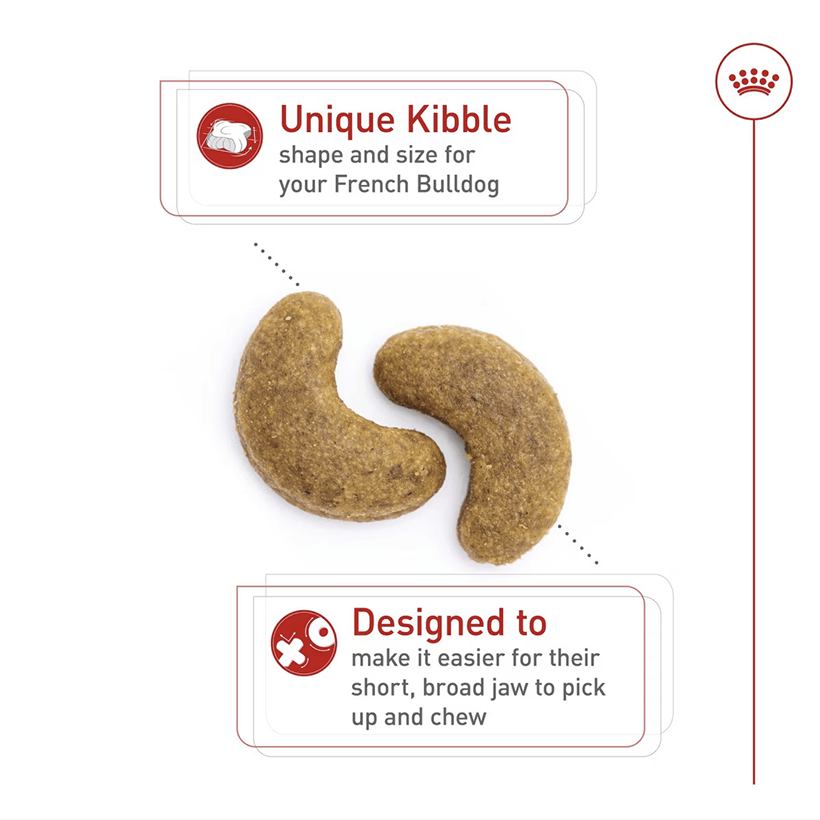
Owner feedback on the kibble shape is split. The majority report that the curved design works as intended — dogs that previously gulped standard kibble now chew more deliberately, resulting in less coughing, choking, and regurgitation. Multiple owners describe the difference as immediate and obvious. However, a notable subset of Frenchie owners report the opposite experience: the kibble is too large for their particular dog's mouth, leading to choking, spitting pieces back up, or difficulty eating. This is consistent with the significant size variation within the breed — a compact 18-lb female and a stocky 31-lb male have meaningfully different jaw dimensions, and a single kibble shape cannot accommodate the full range.
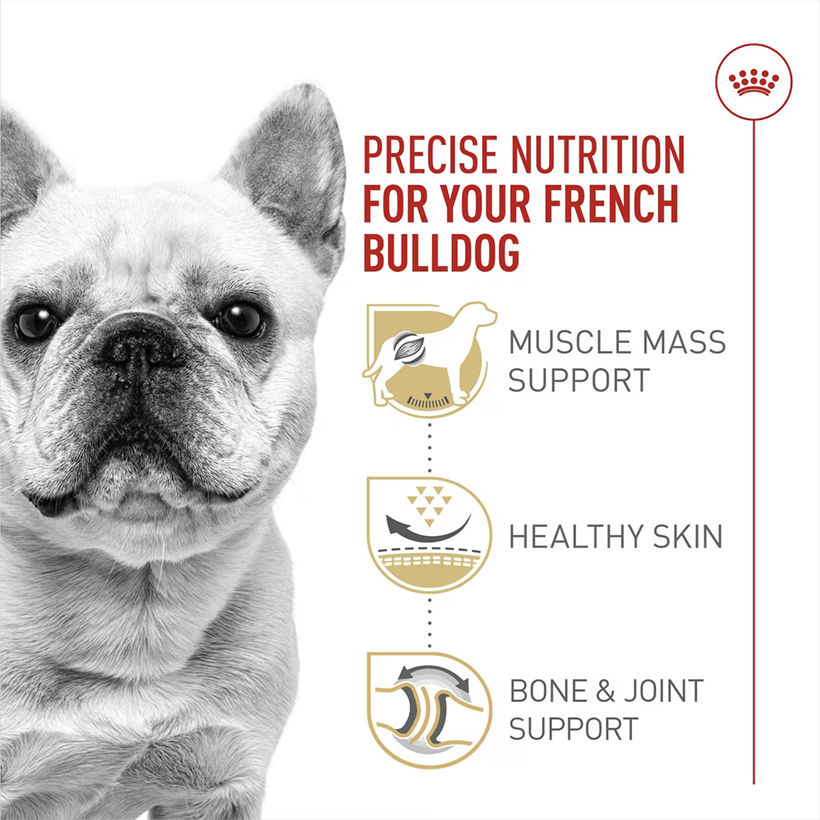
French Bulldogs are among the most dermatologically challenged breeds. Skin fold dermatitis, atopic dermatitis, food-related skin allergies, and chronic ear infections are so common that most Frenchie owners consider them standard breed management issues rather than exceptional health problems. Royal Canin addresses this through a multi-pathway approach: EPA and DHA from fish oil support the skin's lipid barrier, biotin supports keratin production, zinc proteinate supports skin cell regeneration, and L-tyrosine supports healthy pigmentation.
The flatulence reduction claim is addressed through ingredient selection rather than supplementation. The highly digestible proteins (which Royal Canin designates as L.I.P. — Low Indigestibility Protein), controlled fiber levels, and prebiotics from beet pulp and FOS are designed to reduce intestinal fermentation — the primary cause of canine gas. Owner reviews broadly confirm that gas reduction is one of the most noticeable effects of switching to this formula, though results vary and some dogs continue to produce significant flatulence regardless.
Royal Canin owns and operates its U.S. manufacturing facilities in Missouri and South Dakota, maintaining direct control over production quality. The company does not release specific ingredient sourcing details, citing the need to maintain flexibility in meeting quality and safety standards — a transparency approach that frustrates some owners but is standard practice for Mars Petcare brands.
Royal Canin's recall history is minimal relative to its scale. The most significant recall occurred in 2007 during the industry-wide melamine contamination crisis, when Chinese rice protein concentrate tainted multiple brands' products. Royal Canin voluntarily recalled eight Sensible Choice and seven Kasco dry dog food products. A minor 2023 recall affected a single lot of veterinary cat food due to mislabeling. No Royal Canin dog food has been recalled since 2007 — nearly two decades of clean production history across an enormous product volume.
Purina Pro Plan French Bulldog is the most direct competitor — another breed-specific formula from a major manufacturer. Pro Plan offers higher protein content and leads with real chicken rather than brewers rice, which appeals to ingredient-conscious owners. The kibble is also shaped for brachycephalic jaws, and the formula includes probiotics — a notable omission from the Royal Canin formula. Several Frenchie owners on Chewy report switching from Royal Canin to Pro Plan specifically over the kibble size issue, finding the Pro Plan pieces easier for their dogs to manage.
Hill's Science Diet Adult Small & Mini Chicken is not breed-specific but targets small dogs in the same weight range. Hill's delivers comparable protein from chicken as the first ingredient and includes clinically proven antioxidant blends. The smaller kibble size may suit Frenchies that struggle with Royal Canin's larger curved pieces. However, Hill's lacks the breed-specific engineering — custom kibble shape, Frenchie-targeted supplement levels, gas reduction formulation — that define the Royal Canin approach.
The fundamental choice comes down to philosophy: Royal Canin's precision nutrition model delivers targeted solutions for breed-specific problems using ingredients chosen for function over consumer appeal. Competitors like Pro Plan offer cleaner-looking ingredient panels with meat in the first position at comparable or lower prices. For owners who prioritize the breed-specific engineering, Royal Canin is difficult to replicate. For those who prioritize ingredient quality as visible on the label, the alternatives offer compelling value.
This formula earns its price for owners of purebred French Bulldogs dealing with breed-typical gas, skin issues, and eating difficulties. The curved kibble shape genuinely helps most flat-faced dogs eat more effectively. The EPA/DHA skin support, glucosamine for proactive joint care, and digestive fermentation reduction address the three most common Frenchie health management areas. Veterinary endorsement is strong — Royal Canin is one of the most frequently vet-recommended brands, and many breeders send puppies home with Royal Canin feeding guidelines.
The formula is less convincing for owners who prioritize ingredient panel optics. Brewers rice and wheat as the first two ingredients, chicken by-product meal as the primary protein, wheat gluten as a protein booster, and an estimated 40%+ carbohydrate content are legitimate concerns for owners who believe that meat-first, grain-free, or whole-ingredient formulations are inherently superior. The price — roughly $3.30 per pound for the 30-lb bag — places it firmly in premium territory, where many competitors offer higher protein from named whole meats. And the kibble size issue means a meaningful percentage of Frenchie owners find the product physically unsuitable for their specific dog.
Royal Canin French Bulldog Adult maintains strong ratings across Chewy, Petco, and PetSmart, with the overwhelming majority of Frenchie owners reporting positive experiences. The feedback coalesces around several consistent themes.
Picky Frenchie acceptance is the most frequently cited positive. Owners of dogs that rejected multiple other brands describe their French Bulldogs eating Royal Canin eagerly and consistently. The curved kibble shape receives specific praise for enabling brachycephalic dogs to eat without choking or gagging — one owner described it as the first food their Frenchie could eat without coughing pieces back up. Coat improvements are the second most cited benefit, with owners reporting visibly shinier, softer fur within 3–6 weeks. Gas reduction follows — multiple owners describe dramatic decreases in flatulence frequency and intensity after switching.
The negative feedback is equally specific. Kibble size concerns appear repeatedly — some owners find the pieces too large for their individual Frenchie, particularly smaller females and dogs transitioning from the puppy formula, which uses smaller pieces. One owner noted that their dogs could not transition from the puppy to the adult kibble at all due to the size jump. Itchy paws and skin reactions appear in a subset of reviews, suggesting that the wheat, wheat gluten, and chicken by-product components trigger sensitivities in some dogs. Price complaints are consistent — owners acknowledge the quality but find the per-pound cost difficult to sustain, particularly for households with multiple French Bulldogs.
Royal Canin provides detailed weight-based feeding guidelines with separate columns for low-activity and normal-activity dogs. The formula meets AAFCO Dog Food Nutrient Profiles for maintenance of adult dogs over 12 months.
| Dog Weight (lbs) | Low Activity (cups/day) | Normal Activity (cups/day) |
|---|---|---|
| 18 | 1¼ | 1½ |
| 20 | 1⅜ | 1⅝ |
| 22 | 1½ | 1¾ |
| 24 | 1⅝ | 1⅞ |
| 26 | 1¾ | 2 |
| 31 | 2 | 2¼ |
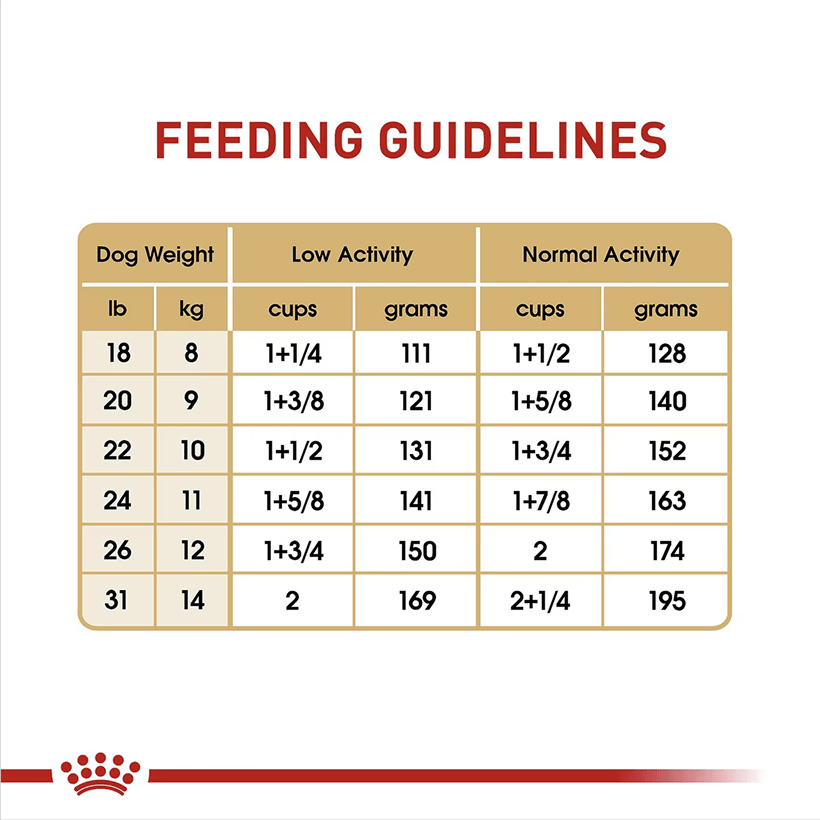
Royal Canin recommends a 7–10 day transition when switching from a previous food, gradually mixing increasing proportions of the new formula with the old. The breed-specific feeding table reflects the typical weight range for adult French Bulldogs. Overweight dogs should be fed at the low-activity level regardless of actual activity, and owners should consult their veterinarian about appropriate portions based on body condition score.
Royal Canin French Bulldog Adult delivers exactly what it promises: a breed-specific formula engineered to address the French Bulldog's flat-face eating mechanics, sensitive skin, digestive gas production, and moderate activity metabolism. The curved kibble shape is not a gimmick — it solves a real feeding problem for most brachycephalic dogs. The EPA/DHA skin support, glucosamine for joint health, and fermentation-reducing digestive formulation target the breed's three most common management areas with genuine nutritional science behind them. Nearly two decades without a dog food recall adds manufacturing credibility.
The formula asks owners to accept trade-offs that many modern pet food consumers find uncomfortable: grains before meat, by-product meal as the primary animal protein, wheat gluten as a protein booster, and a high-carbohydrate macronutrient profile — all at a premium price. Royal Canin's position is that nutrient delivery matters more than ingredient source, and that their veterinary-backed formulation expertise outweighs consumer preferences for meat-first labels. For Frenchie owners whose dogs thrive on this formula — eating without choking, passing less gas, maintaining healthy skin — that argument is easy to accept. For those whose dogs react to the wheat or by-products, or who cannot reconcile the ingredient panel with the price tag, the market offers alternatives that lead with whole meats at competitive cost.
Ready to try Royal Canin?
Check Best Price →Some links on this page are affiliate links. We may earn a small commission at no extra cost to you.
Royal Canin formulates based on nutrient delivery rather than ingredient order. The company argues that brewers rice and wheat provide highly digestible carbohydrate energy while chicken by-product meal in the third position delivers concentrated protein. This approach prioritizes digestive efficiency for a breed prone to gastrointestinal fermentation over the meat-first label optics that many competitors pursue.
The kibble is a curved, boomerang-like shape designed specifically for the French Bulldog's brachycephalic jaw and undershot bite. The curve allows dogs to scoop food with the lower jaw rather than requiring front-teeth picking, and the larger-than-expected size forces chewing instead of gulping — reducing air intake, choking, and gas.
Many owners report noticeable gas reduction after switching to this formula. Royal Canin uses highly digestible proteins, precise fiber levels, and prebiotics to reduce intestinal fermentation — the primary cause of canine flatulence. Results vary, and some dogs continue to produce significant gas regardless of diet.
No. The formula contains brewers rice, wheat, and wheat gluten as primary carbohydrate and structural ingredients. Dogs with confirmed grain allergies should not eat this food.
No. This formula is designed for adult French Bulldogs over 12 months old. Royal Canin offers a separate French Bulldog Puppy formula with adjusted nutrients for growth, a different caloric density, and smaller kibble pieces suited to a developing jaw.