Dog Food
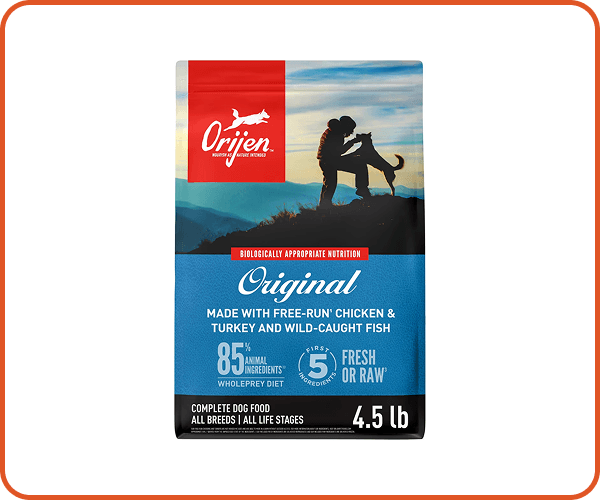
Orijen Original Grain-Free High-Protein Review
Fresh chicken, turkey, and salmon lead the panel, no meals in the top five, with 43% DMB protein.
Read Review →
Orijen was born from a gap that Champion Petfoods' founder Reinhard Muhlenfeld saw in his own lineup. By the early 2000s, Acana had built a loyal following as a high-protein, regionally sourced pet food — but Muhlenfeld wanted to push the concept further. What would happen if you built a kibble where 85% or more of the ingredients came from fresh or raw animal sources, mirroring what a wild canine or feline would actually eat? In 2005, Orijen launched as the answer. The name — a play on "origin" — was chosen to reflect the brand's philosophy of returning to the ancestral diet. From day one, it positioned itself not as premium pet food, but as the most biologically authentic dry food on the market. The approach earned Orijen the title of "World's Best Cat Litter" at multiple international pet food expos and a fanatical customer base willing to pay top dollar. In 2023, Mars Incorporated acquired Champion Petfoods, making Orijen a corporate sibling of Pedigree, Royal Canin, and Whiskas — a combination that still makes some loyalists uneasy.
Every pet food brand has a philosophy. Most of them are marketing. Orijen's WholePrey concept, while certainly marketed aggressively, is backed by a genuinely unusual formulation approach. In the wild, a wolf or wildcat does not eat a deboned chicken breast — it eats the entire animal: muscle meat, liver, kidney, heart, cartilage, and bone. Each organ delivers a different nutrient profile that, combined, provides complete nutrition without synthetic supplementation. Orijen replicates this by including fresh or raw meat as the foundation, then adding organ meats like liver and kidney for vitamins A and B, tripe for digestive enzymes, and bone for calcium and phosphorus. The result is a food that requires far fewer synthetic vitamin and mineral supplements than conventional kibble — a distinction visible on the ingredient label, where Orijen's additive list is noticeably shorter than competitors'. Whether this matters nutritionally beyond meeting AAFCO standards is debated among veterinary nutritionists, but the logic is sound: the closer a food comes to whole-animal nutrition, the less it needs to compensate with added synthetics.
There is no way around it: Orijen is one of the most expensive dry pet foods on the market. A 25-pound bag of Original Dog typically retails between $85 and $100, and the freeze-dried and fresh lines cost significantly more. That price reflects what goes into the bag. The first five ingredients in every Orijen dry recipe are fresh or raw animal proteins — not meals, not concentrates. Free-run chicken and turkey, wild-caught fish, nest-laid eggs, and ranch-raised red meats arrive at Champion's kitchens within 48 hours of harvesting and are refrigerated (fresh) or flash-frozen (raw) until processing. Champion manufactures everything in-house at two company-owned facilities: the NorthStar Kitchen in Edmonton, Alberta, and the DogStar Kitchen in Auburn, Kentucky — a $300 million, 371,000-square-foot plant that received the Global Food Safety Initiative's first-ever Global Markets Award in 2017. No co-packers, no outsourced production. The current portfolio spans dry kibble, freeze-dried food and treats, wet food, and the brand-new FreshPrey line — gently cooked sous vide meals launched at Petco in early 2026, marking Orijen's entry into the booming fresh pet food category.
Orijen has never been recalled in North America. The single recall in its history occurred in 2008 in Australia, where imported Orijen cat food was subjected to mandatory gamma irradiation — a quarantine treatment required by Australian authorities at the time. The irradiation depleted vitamin A and created oxidative by-products in the food, causing neurological illness in multiple cats. Champion responded aggressively: it voluntarily recalled the affected products, funded veterinary care for affected cats, and successfully lobbied the Australian government to ban gamma irradiation of pet food — a policy change that Champion is credited with driving. It was a failure caused by a third-party government process, not by the food itself, and no similar incident has occurred since. The ongoing controversy is the same one that shadows Acana: the Mars acquisition. Champion insists that formulation, sourcing, and manufacturing remain unchanged. Sceptics note that every premium brand acquired by a multinational — Merrick by Nestlé, Nutro by Mars, Natural Balance by Smucker — eventually saw some degree of reformulation. For now, the ingredient panels have not changed, the kitchens have not changed, and the recall record remains clean. But the pet food community is watching closely, and any perceived quality shift will be met with vocal backlash from one of the most loyal customer bases in the industry.
1 review — sorted by rating.
Fresh chicken, turkey, and salmon lead the panel, no meals in the top five, with 43% DMB protein.
Read Review →