
Whether your cat needs a new diet for health reasons, you're switching to a more affordable brand, or you've simply run out of the old food — changing cat food the wrong way can lead to vomiting, diarrhea, and outright food refusal. Cats are creatures of habit, and their digestive systems aren't designed for sudden dietary changes. The gut bacteria and enzymes in your cat's intestines are specifically adapted to break down the proteins, fats, and carbohydrates in their current food — introduce something completely different overnight, and digestive chaos follows.
The good news? With the right approach, you can switch your cat's food safely and smoothly — even with the pickiest eaters. This guide covers everything: when to change, how fast to transition, what to do when your cat refuses, and how to handle special situations like switching from dry to wet food or transitioning multiple cats at once.
When Should You Change Your Cat's Food?
Before diving into the how, it's worth understanding the why. There are several legitimate reasons to switch your cat's food, and knowing yours helps you choose the right replacement.
Life stage changes — kittens, adults, and seniors have different nutritional needs. A kitten eating adult food isn't getting enough calories and protein for growth. A senior cat on kitten food may gain excess weight. Transition when your cat hits a new life stage: around 12 months (kitten to adult) and around 7 years (adult to senior).
Health issues — your veterinarian may recommend a dietary change for digestive problems, urinary issues, kidney disease, weight management, food allergies, or skin conditions. Always follow your vet's guidance on which food to switch to.
Food discontinuation or recall — if your cat's current food has been discontinued, reformulated, or recalled, you'll need to find an alternative. This is one of the most stressful scenarios because the timeline is often forced.
Budget changes — life circumstances change, and sometimes a more affordable food is necessary. This is perfectly valid — many mid-range and budget foods provide complete and balanced nutrition.
Persistent food refusal — some cats gradually lose interest in a food they once loved. If your cat is consistently eating less or leaving food uneaten, it may be time to try something new.
One scenario where you should not change food: boredom-based switching when your cat is healthy and eating well. Unlike humans, cats don't need variety for variety's sake. If it's working, don't fix it.
The 7-Day Cat Food Transition Schedule
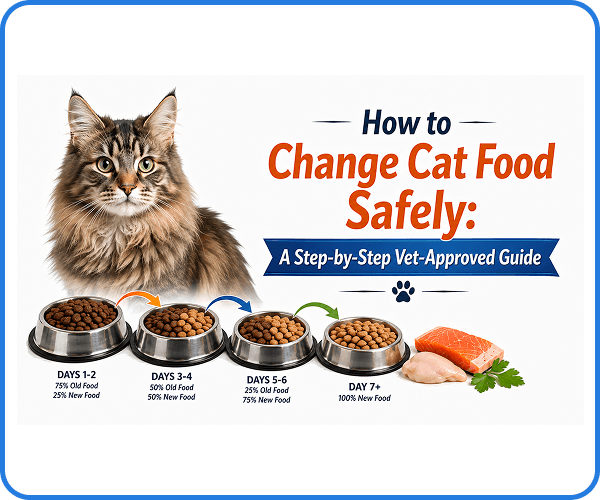
This is the standard veterinary-recommended approach to switching cat food, endorsed by PetMD, the American Animal Hospital Association, and virtually every veterinary nutritionist. The goal is to gradually shift the ratio of old food to new food over 7 days, giving your cat's gut bacteria time to adapt.
| Day | Old Food | New Food |
|---|---|---|
| Day 1–2 | 75% | 25% |
| Day 3–4 | 50% | 50% |
| Day 5–6 | 25% | 75% |
| Day 7+ | 0% | 100% |
Important: Mix the foods thoroughly. According to the American Animal Hospital Association, combining the foods well prevents your cat from picking out only the familiar pieces and leaving the new food behind.
This schedule works for most cats. However, if your cat has a sensitive stomach, has had difficulty with food changes before, or is particularly stubborn, consider the extended timeline below.
The Extended 14-Day Transition for Picky or Sensitive Cats
Some cats need more time — and that's okay. If the 7-day schedule causes digestive upset or food refusal, slow down and extend the transition to 10–14 days. Start with just 5–10% new food on day one and increase by roughly 10% every one to two days.
| Day | Old Food | New Food |
|---|---|---|
| Day 1–2 | 90% | 10% |
| Day 3–4 | 80% | 20% |
| Day 5–6 | 70% | 30% |
| Day 7–8 | 50% | 50% |
| Day 9–10 | 30% | 70% |
| Day 11–12 | 15% | 85% |
| Day 13–14 | 0% | 100% |
The golden rule: if your cat shows signs of digestive upset at any stage, go back to the previous ratio and hold there for 2–3 days before trying to move forward again. Patience is everything with picky cats.
What to Do When Your Cat Refuses the New Food
This is the most common frustration cat owners face — and it's where most transitions fail. Cats can be remarkably stubborn about food changes, and some will choose to starve rather than eat something unfamiliar. Here's how to handle it.
Warm the food slightly — warming food to just below body temperature (around 35°C / 95°F) releases aromas that make it more appealing. This is especially effective with wet food. Microwave for 5–10 seconds and stir to eliminate hot spots.
Add a flavor enhancer — a small amount of low-sodium chicken broth, tuna water (from a can of tuna in water, not oil), or a teaspoon of the liquid from wet cat food can make the new food smell and taste more familiar. Some owners have success sprinkling a tiny amount of nutritional yeast on top.
Try a different texture first — if you're switching brands but staying within dry food, try the new brand's wet food version as a topper first. Cats often accept new flavors more readily in wet form because the aroma is stronger.
Offer smaller, more frequent meals — instead of two large meals, try four smaller ones throughout the day. Hungry cats are less picky, and smaller portions feel less overwhelming.
Remove uneaten food after 30 minutes — don't leave food out all day. Structured mealtimes create gentle hunger that motivates your cat to try the new food at the next serving. Free-feeding picky cats makes transitions nearly impossible.
Don't give in and offer treats instead — if your cat learns that refusing food leads to treats, you've created a much bigger problem. Stay consistent with the transition food and resist the urge to substitute.
How Long Can a Cat Safely Go Without Eating?
This is a critical safety concern that every cat owner needs to understand during a food transition. While a healthy adult cat can technically survive several days without food, going more than 24–48 hours without eating is dangerous — especially for overweight cats.
When cats stop eating, their bodies begin mobilizing fat stores for energy. In overweight cats, this can trigger hepatic lipidosis (fatty liver disease) — a potentially fatal condition where the liver becomes overwhelmed by fat. This can develop in as little as 2–3 days of fasting in susceptible cats.
If your cat has refused all food for more than 24 hours during a transition, go back to the old food immediately. Your cat's short-term nutrition is more important than completing the transition on schedule. You can try again later with a slower approach. If your cat still won't eat the old food, contact your veterinarian — this may indicate a health issue beyond simple pickiness.
How to Switch from Dry Food to Wet Food
Switching between food types (dry to wet or wet to dry) is often harder than switching between brands of the same type. Many cats that have eaten dry food their entire lives may not even recognize wet food as edible — the texture, smell, and temperature are completely foreign.
Start by placing a small amount of wet food next to the dry food — don't mix them initially. Let your cat investigate and taste on their own terms. Some cats take several days just to accept wet food's presence in the bowl.
Sprinkle crushed dry food on top of the wet food — this creates a familiar crunch and scent that bridges the gap. Gradually reduce the amount of dry food topping over time.
Try different textures — wet food comes in paté, shredded, chunks in gravy, and minced varieties. Some cats that reject paté will happily eat shredded chicken in gravy. Experiment with textures before assuming your cat doesn't like wet food at all.
Adjust portions carefully — wet food is mostly water (typically 75–85% moisture), so your cat needs a larger volume of wet food to get the same calories as dry food. A cat eating ½ cup of dry food may need one full can (5.5 oz) or more of wet food per day to maintain the same caloric intake. Always check the feeding guidelines on the new food.
How to Switch from Wet Food to Dry Food
The opposite transition — wet to dry — comes with different challenges. Cats accustomed to wet food may find dry kibble less aromatic, less palatable, and harder to chew.
Add warm water or broth to the dry food — this softens the kibble and releases more aroma, making it closer to the wet food experience your cat is used to. Gradually reduce the liquid over 1–2 weeks until your cat accepts dry kibble on its own.
Offer dry food as a "treat" between wet meals first — leave a small amount of dry food available between scheduled wet meals. Some cats begin snacking on it out of curiosity, which builds familiarity before you start the formal transition.
Ensure adequate hydration — cats switching from wet to dry food lose a significant source of daily water intake. Make sure fresh water is always available, and consider a cat water fountain — many cats drink significantly more from running water than a still bowl.
Switching Cat Food in Multi-Cat Households
Multi-cat homes add a layer of complexity, especially when only one cat needs a diet change while the others stay on their current food.
Feed cats separately — this is the most reliable solution. Use separate rooms or feed at different times to ensure each cat eats only their designated food. This also prevents the cat on the old food from eating the transitioning cat's food (and vice versa).
Use microchip-activated feeders — these high-tech bowls open only for the cat whose microchip is registered, preventing food theft. They're an investment, but invaluable in multi-cat households with different dietary needs.
If all cats are transitioning to the same new food — follow the standard 7-day schedule for everyone simultaneously. Monitor each cat individually, as some may adapt faster than others. The slowest cat sets the pace for the household.
Signs the Transition Is Going Well
How do you know the switch is working? Look for these positive indicators:
Consistent appetite — your cat is eating the mixed food without hesitation and finishing meals at a normal pace.
Firm, well-formed stools — stool quality is the best barometer of digestive adaptation. Normal stools mean the gut bacteria are adjusting well.
Normal energy and behavior — your cat is active, playful, and behaving normally. No lethargy or hiding.
No vomiting — occasional hairball-related vomiting is normal for cats, but vomiting after meals during a transition is a red flag to slow down.
Warning Signs: When to Stop and Call Your Vet
Stop the transition and contact your veterinarian if you notice any of the following:
Complete food refusal for more than 24 hours — as discussed above, this is a health risk, not just stubbornness.
Persistent vomiting or diarrhea — occasional soft stools during the first 2–3 days can be normal, but anything lasting beyond that or accompanied by vomiting needs veterinary attention.
Blood in stool or vomit — this is never normal and requires immediate veterinary evaluation.
Lethargy, hiding, or behavioral changes — if your cat is withdrawn, sleeping more than usual, or showing signs of discomfort, something beyond a simple food transition may be happening.
Weight loss — if your cat is eating significantly less during the transition and you notice visible weight loss, consult your vet.
Tips for a Stress-Free Cat Food Transition
Never switch during stressful periods — moving to a new home, introducing a new pet, having houseguests, or any major household change adds stress that makes food transitions harder. Wait until your cat's environment is stable before starting.
Buy enough of both foods — make sure you have sufficient old food to last the entire transition period. Running out of old food mid-transition forces an abrupt switch, defeating the entire purpose.
Keep the feeding location consistent — cats are sensitive to environmental changes. Feed in the same quiet spot at the same times throughout the transition.
Keep a transition log — note the daily ratio, your cat's appetite, stool quality, and any changes in behavior. This simple record helps you identify what's working and when to adjust.
Consider adding a probiotic — a cat-specific probiotic supplement during the transition can support gut bacteria adaptation and reduce digestive upset. This is especially helpful for cats with historically sensitive stomachs.
3 Products That Make Cat Food Transitions Easier
Sometimes a smooth transition needs a little extra help. These three products are specifically useful during food changes — whether your cat is picky, has a sensitive stomach, or simply refuses to cooperate.
1. Fancy Feast Classic Paté Collection
When all else fails, Fancy Feast Classic Paté is the food most picky cats will eat. It's often called the "gateway food" by cat owners for good reason — the smooth paté texture, strong aroma, and wide variety of flavors (chicken, beef, turkey, seafood, liver) make it nearly irresistible to even the stubbornest cats. If your cat is refusing a new dry food, mixing a tablespoon of Fancy Feast paté into the kibble can jumpstart acceptance. Available in 30+ flavors, making it easy to find the one your cat responds to. Budget-friendly at roughly $0.70 per can.
Best for: Cats refusing new food entirely — use as a temporary flavor bridge to get them eating again during a difficult transition.
2. INABA Churu Lickable Cat Treats
INABA Churu has become one of the most popular cat products in the world — and for transitions, it's a secret weapon. These creamy, lickable purée tubes are so irresistible that most cats will eat anything they're squeezed onto. During a food switch, squeeze half a Churu tube on top of the new food to make it smell and taste familiar. At only 6–9 calories per tube, they won't disrupt your cat's nutritional balance. The moisture also helps hydration, especially useful when transitioning from wet to dry food.
Best for: Making unfamiliar food smell and taste appealing — the ultimate bribe for picky cats during any transition.
3. Purina Pro Plan Veterinary Supplements FortiFlora
FortiFlora is the #1 veterinarian-recommended probiotic for cats, and it's specifically designed for situations like food transitions. Each packet contains a guaranteed level of live, active Enterococcus faecium SF68 — a clinically studied probiotic strain that supports intestinal microflora balance during dietary changes. Sprinkle one packet daily over your cat's food during the transition period. Beyond gut support, FortiFlora has a highly palatable flavor that many cats love, which adds a bonus appetite-stimulating effect on top of the probiotic benefits.
Best for: Supporting digestive health during any food switch — especially for cats prone to loose stools, gas, or vomiting when changing diets.
Final Thoughts: Patience Is the Secret Ingredient
Switching cat food isn't complicated — but it does require patience, consistency, and respect for your cat's pace. The biggest mistake owners make is rushing. Whether it takes 7 days or 21 days, a slow, successful transition is infinitely better than a fast, failed one that leaves your cat stressed, sick, or refusing to eat entirely.
Start with the 7-day schedule, watch your cat's response, and adjust as needed. Warm the food, mix it thoroughly, and never let your cat go more than 24 hours without eating. When in doubt, go slower — your cat's digestive system will thank you.
Frequently Asked Questions
How long does it take to switch cat food?
The standard veterinary recommendation is 7–10 days using a gradual mixing schedule. Picky or sensitive cats may need 14 days or longer. The key is monitoring your cat's appetite and stool quality and adjusting the pace accordingly.
Can I switch my cat's food cold turkey?
This is strongly discouraged. Abrupt food changes can cause vomiting, diarrhea, and complete food refusal. The only exception is if your veterinarian specifically instructs an immediate switch for medical reasons.
Why does my cat vomit when I change food?
Your cat's gut bacteria and digestive enzymes are adapted to the old food. Introducing new ingredients too quickly overwhelms the digestive system. Slow down the transition, go back to the last ratio that worked, and increase the new food more gradually.
Is it okay to mix two brands of cat food together?
Yes, mixing during a transition is exactly what veterinarians recommend. Both foods should be AAFCO-compliant and complete. Mix them thoroughly so your cat can't pick out individual pieces. Once the transition is complete, feed only the new food.
My cat won't eat the new food at all — what should I do?
Try warming the food slightly, adding a splash of low-sodium chicken broth or tuna water, starting with an even smaller percentage of new food (5% instead of 25%), or trying a different texture. If your cat refuses all food for more than 24 hours, go back to the old food and consult your veterinarian.